For anyone comparing a 3d ai maker for web-ready 3D assets, this review shows how Tripo AI and SupaVoxel differ in geometry, textures, file weight, and the unseen back of a skull generated from a single view.
Independent review. I ran both tools on my own accounts, free and paid, with no vendor-provided access or early access of any kind.
My verdict in 60 seconds — Tripo 60/100, SupaVoxel 90/100
One three-quarter photograph of an anatomical skull ornament, run once through Tripo and once through SupaVoxel. Tripo returned 62.70 MB, 1,952,540 triangles, 7.25 MB of textures, for 55 credits. SupaVoxel returned 5.37 MB, 960,138 triangles, 0.51 MB of textures, for 3. This article is about what each file actually looks like at the same camera, and what it weighs on the way to a viewer.
- File size — Tripo 62.70 MB · SupaVoxel 5.37 MB · 11.67×
- Bytes per triangle — Tripo 32.11 B · SupaVoxel 5.59 B · Tripo shipped no compression extension at all
- baseColor texture — Tripo 2.44 MB 4096 JPEG · SupaVoxel 0.28 MB 2048 WebP · Tripo wins this for rendering
- Textures a slicer never opens — Tripo 4.81 MB · SupaVoxel 0.23 MB · 21.1×, including a 3.38 MB uncompressed 4096 PNG normal map
- First load on 12 Mbps 4G — Tripo 41.8 s · SupaVoxel 3.6 s · 38.2 s of waiting
- CDN at 10,000 loads/month — Tripo $53.29 · SupaVoxel $4.57 · $584.60 a year
- Geometry VRAM — Tripo 55.4 MB · SupaVoxel 27.4 MB · 2.02×
- The invented occiput — Tripo featureless egg · SupaVoxel featureless egg · nobody wins, and Tripo paid 11.67× for it
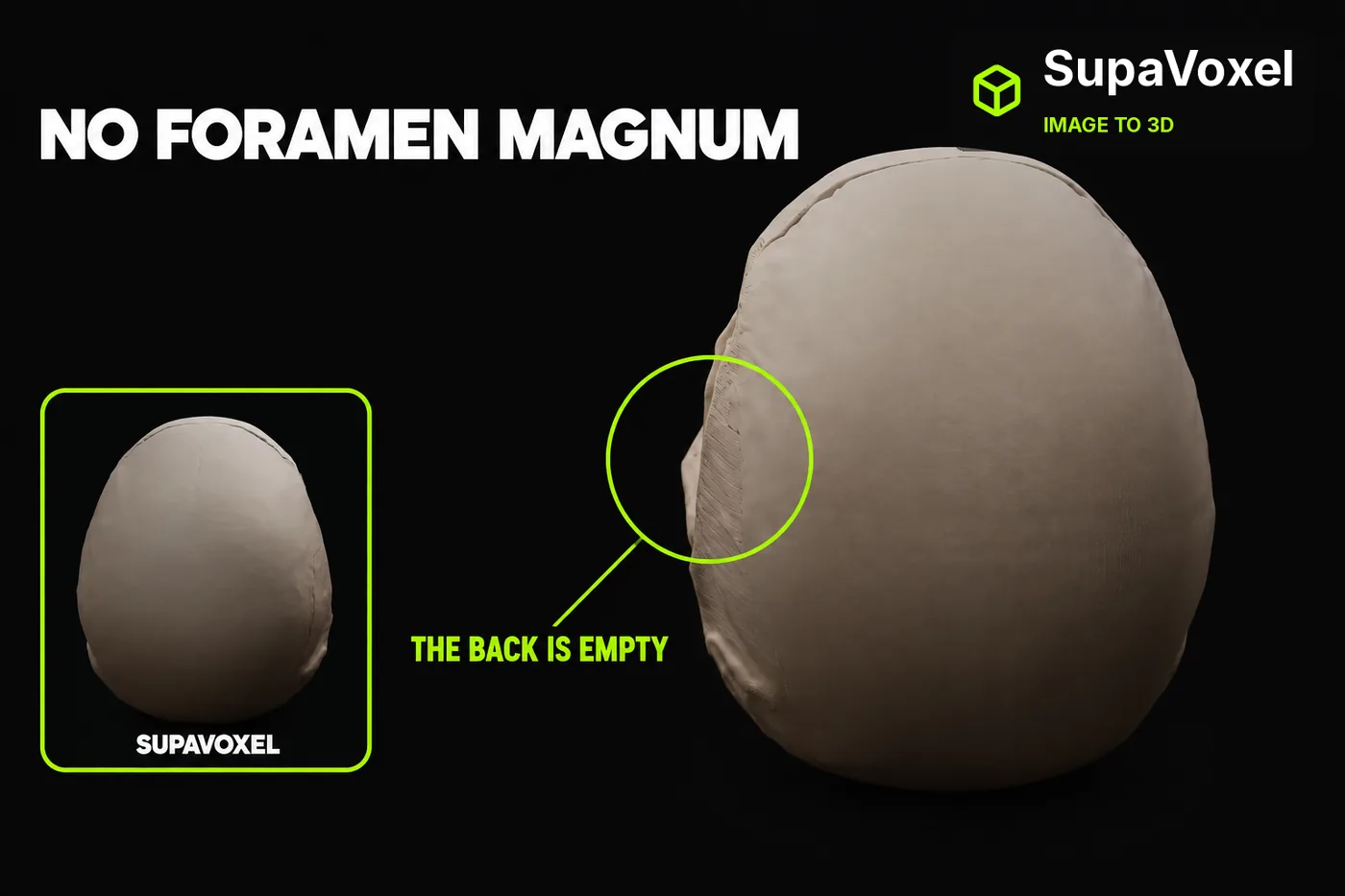
The headline of this test is about a half of the object neither product could see. The input is shot from the front-three-quarter, so the back of the cranium has no pixels at all, and both models invented it. Both invented the same nothing: a smooth egg with no external occipital protuberance, no nuchal lines and no foramen magnum. Tripo then made it worse, by extruding the reference photo's cranial crack into a raised torn ridge and carrying the wood-grain banding around the back. Eleven-and-a-half times the bytes bought Tripo no anatomy on that half and did buy artefacts.
If you are putting this model in front of a person — a product page, a phone, a print — SupaVoxel is the one I'd use. Tripo's 4096 baseColor is genuinely the better texture, and it arrives inside a 62.70 MB download that takes 41.8 seconds on a phone.
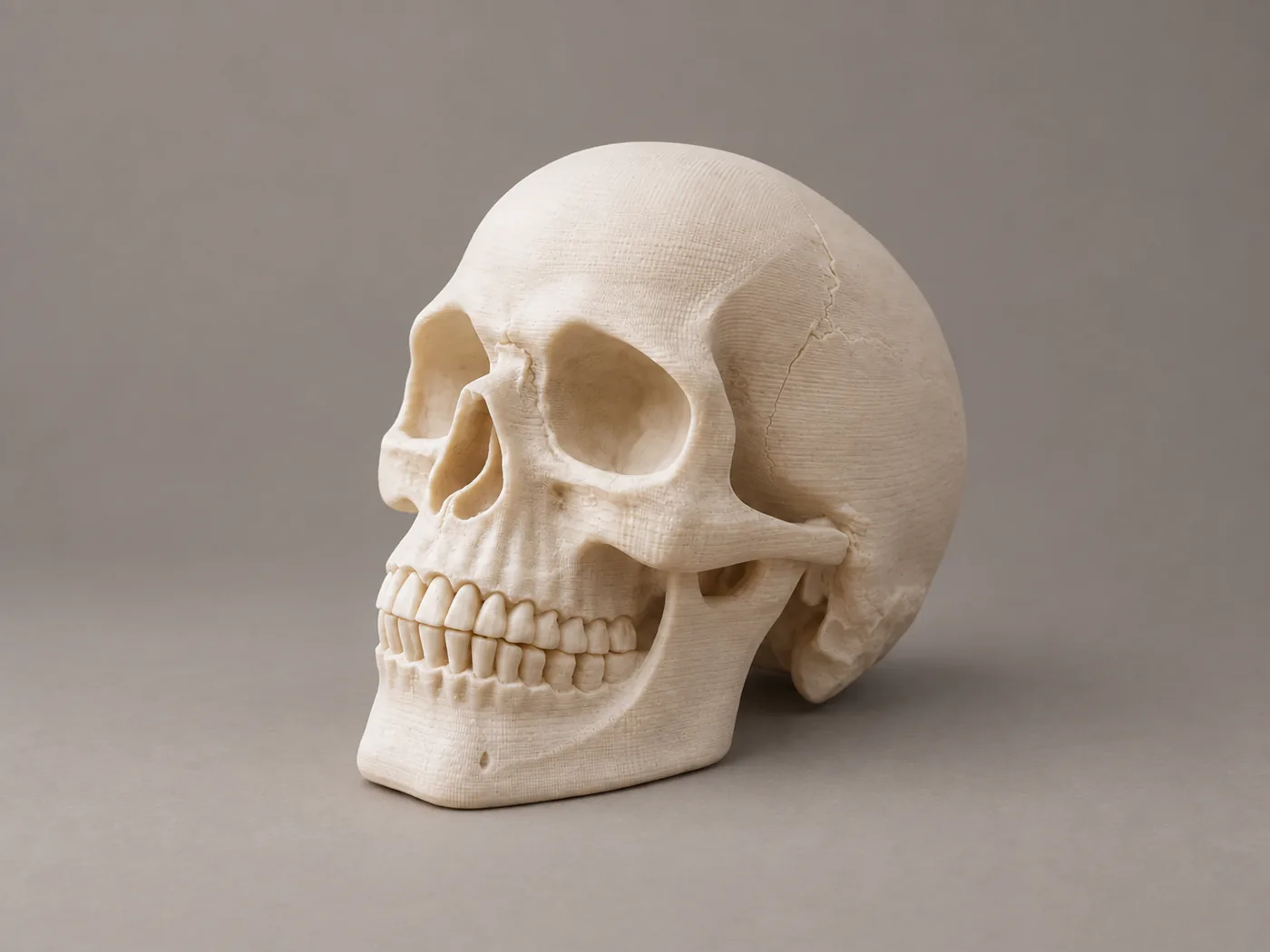 The input, identical on both sides. Front-three-quarter: full occlusion, a free-standing left zygomatic arch, a crack across the parietal, and a layer of horizontal wood grain. Everything behind the coronal plane is guesswork for both products.
The half the camera never saw
Turn both models around. SupaVoxel's occiput is a smooth ovoid with exactly one structure on it: a clean mid-sagittal suture running down from the vertex. No external occipital protuberance. No superior or inferior nuchal lines. No foramen magnum. It is clean, and it is empty.
Tripo's occiput is a smooth ovoid with no external occipital protuberance, no nuchal lines and no foramen magnum either — plus a raised tear-like ridge down the left side, which is the parietal crack from the photograph continued past the edge of the photograph, and the horizontal wood banding carried all the way round the cranium.
So the comparison on this half is not "detailed against vague". It is "empty against empty, one of them with artefacts". Tripo spent 62.70 MB and 1,952,540 triangles and got a rear view with strictly less anatomy than a $12 plastic teaching skull.
- Occipital protuberance — Tripo absent · SupaVoxel absent
- Nuchal lines — Tripo absent · SupaVoxel absent
- Foramen magnum — Tripo absent · SupaVoxel absent
- Invented surface detail — Tripo a torn ridge and photo banding · SupaVoxel a mid-sagittal suture
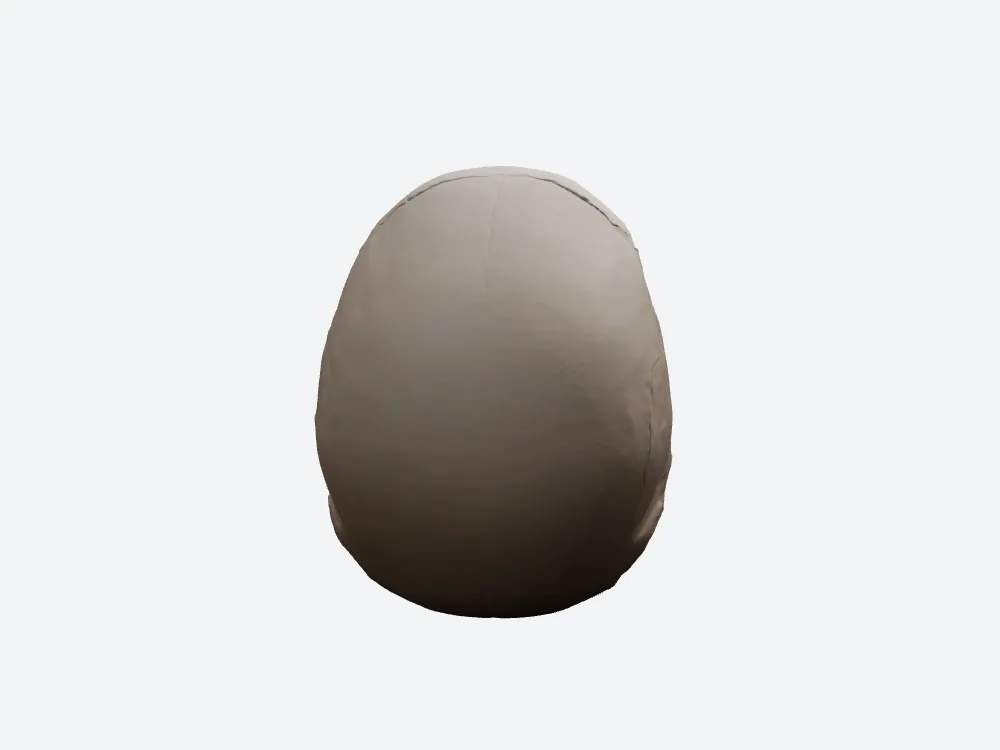 SupaVoxel, rear. One suture along the top and nothing else. Empty, but it is bone-coloured, smooth and printable without post-work.
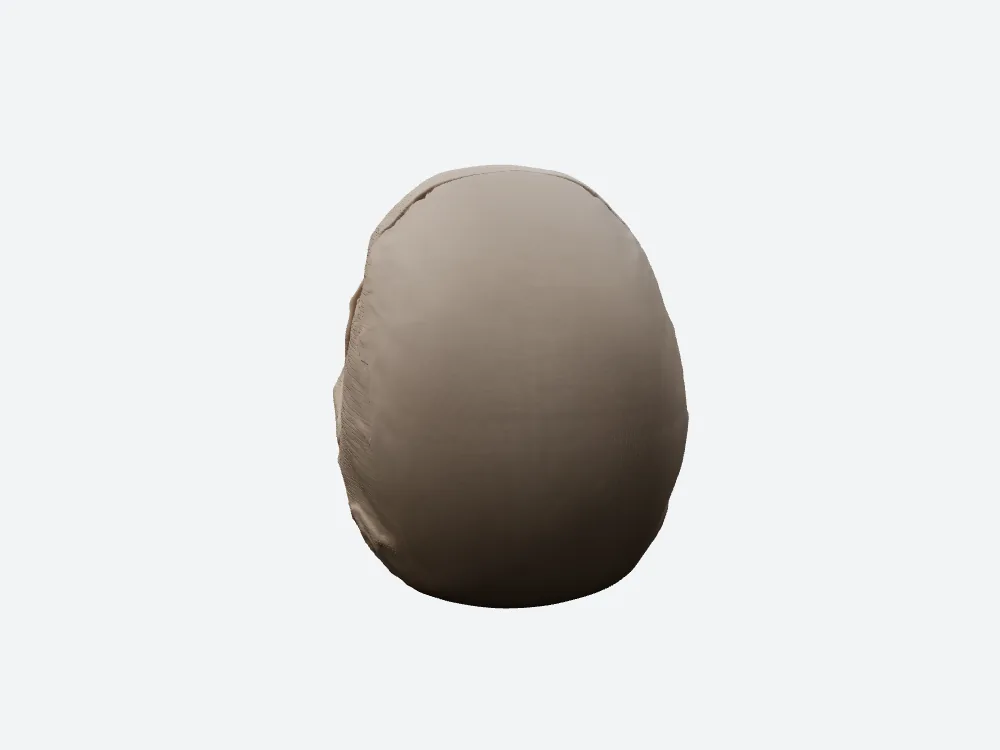 Tripo, rear, same camera. Equally empty of anatomy, plus a raised torn ridge on the left and horizontal banding wrapped round the back.
Tripo kept painting the photograph where the photograph ends
Zoom in on both rear views and the difference in kind becomes clear. SupaVoxel's stays a single smooth surface — one fine straight suture at the top, a few soft bulges near the right margin. Nothing to praise, nothing to fix.
Tripo's zoom shows two things: the torn ridge along the left margin has the wood banding extruded along it, and a faint horizontal light-dark band persists across the whole surface. Tripo did not extrapolate a skull onto the unseen half. Tripo extrapolated a photograph of a wooden ornament onto it.
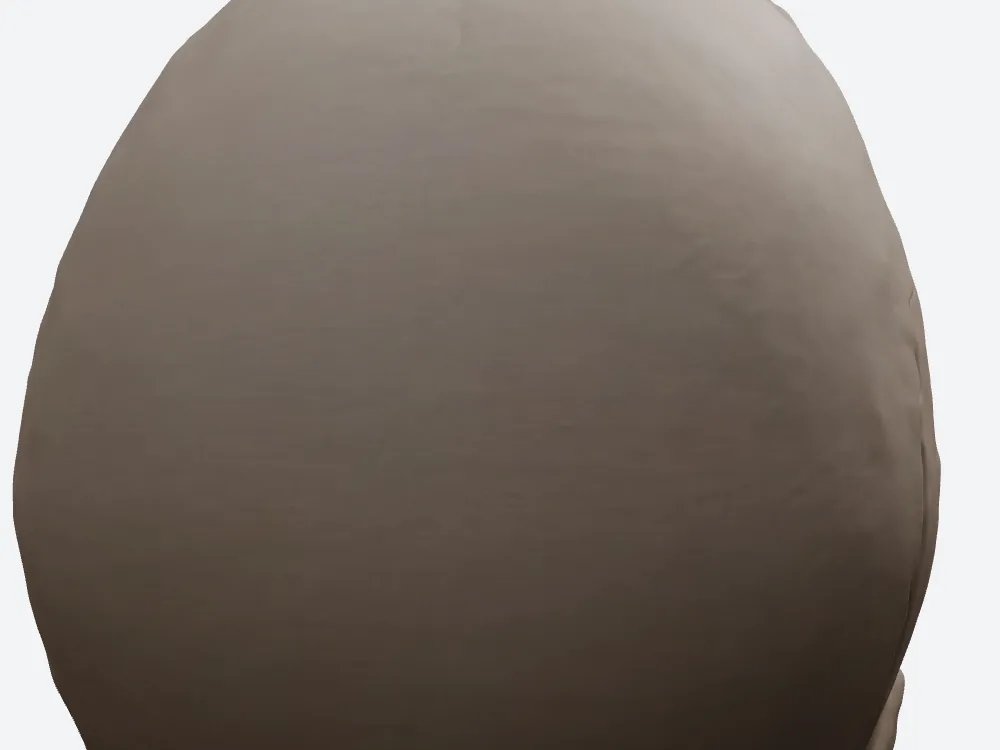 SupaVoxel, rear, tight crop. Smooth, and honestly featureless.
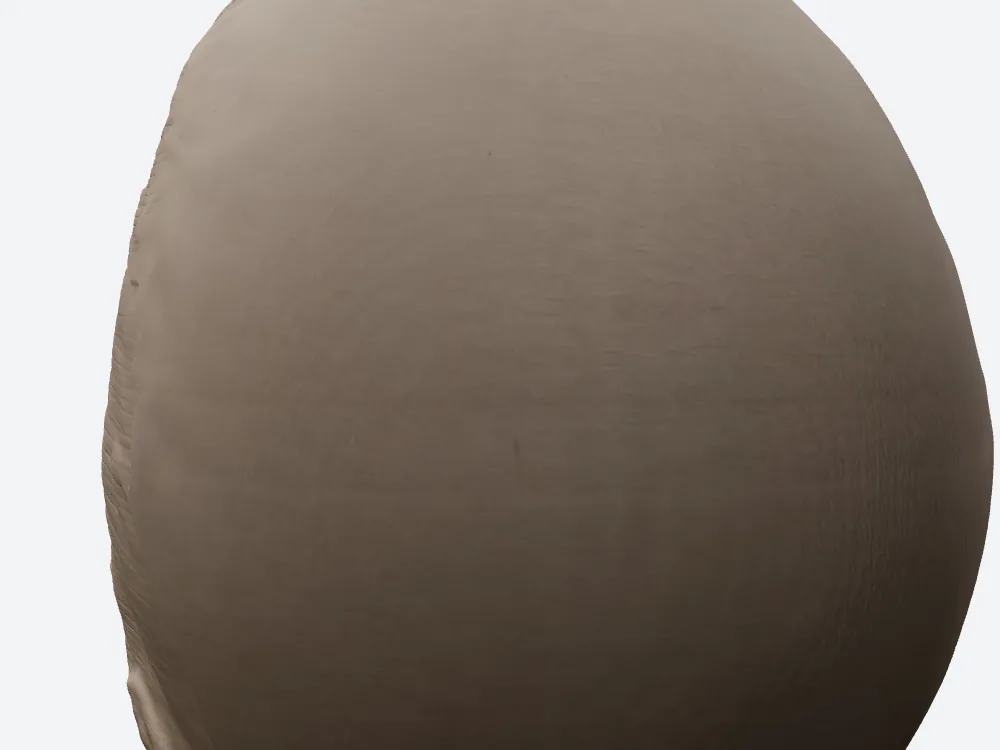 Tripo, rear, tight crop. The banding is extruded along the torn ridge, and a faint horizontal rhythm runs across the whole invented surface.
The grain is in the geometry, not the texture
This is the measured version of the complaint. Render both meshes with every texture removed. SupaVoxel's bare mesh is smooth bone — the orbital rims, nasal bones, arch and teeth are all shape, and the parietal crack is an incised line. Tripo's bare mesh still has the horizontal ripple across the entire vault and face.
The wood grain is displaced into Tripo's vertices. No material change removes it; on a print it is physical corrugation. It is also where a large share of Tripo's 1,157 sliver faces live, against 6 in the SupaVoxel file.
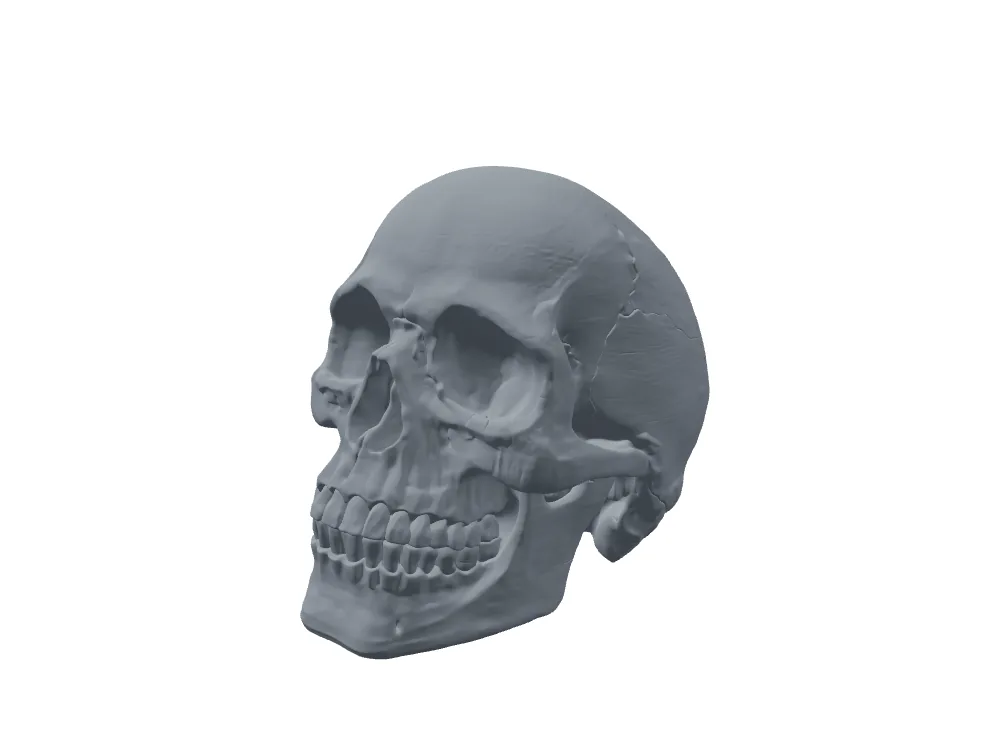 SupaVoxel, textures off. Clean bone — the grain was discarded rather than modelled.
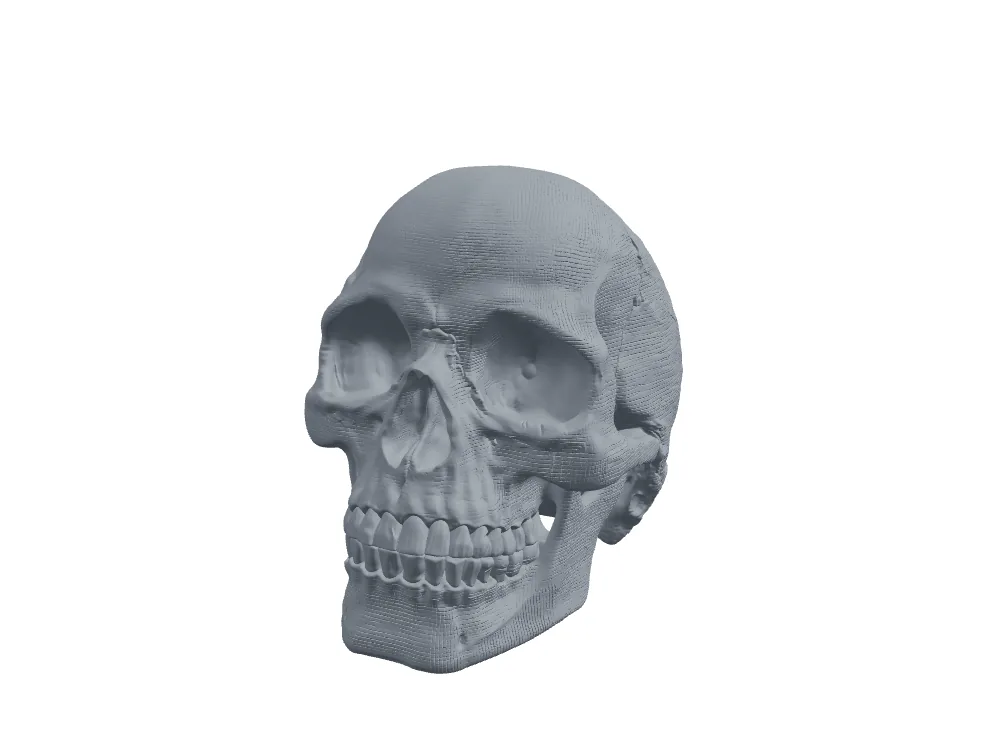 Tripo, textures off. Still corrugated.
Front view: rounder features under a striped frontal bone
At the same camera, Tripo's orbital rims and nasal aperture are one notch rounder than SupaVoxel's and the mandibular angle is squarer. SupaVoxel's has harder edges — the orbital margins, nasal spine and vomer ridge each throw their own shadow.
Then look at the bone surface. Tripo's frontal and parietal are visibly striped with the ornament's grain; SupaVoxel's are plain. If you want a photograph of that ornament, Tripo is closer. If you want a skull, SupaVoxel is.
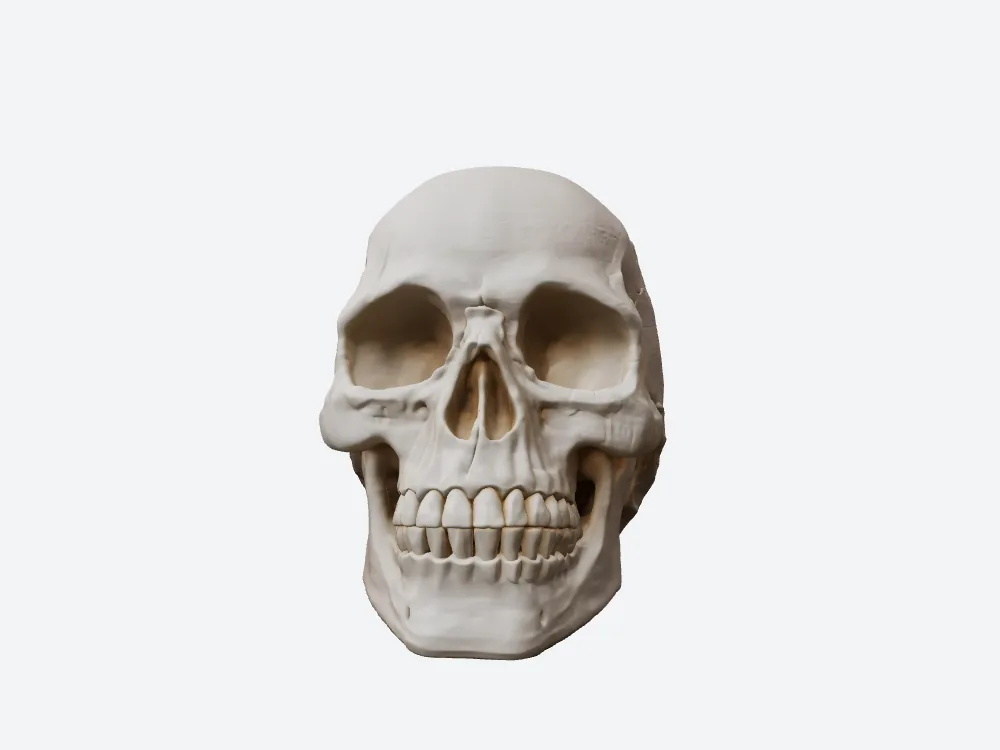 SupaVoxel, front. Hard edges, clean vault, individually separated crowns.
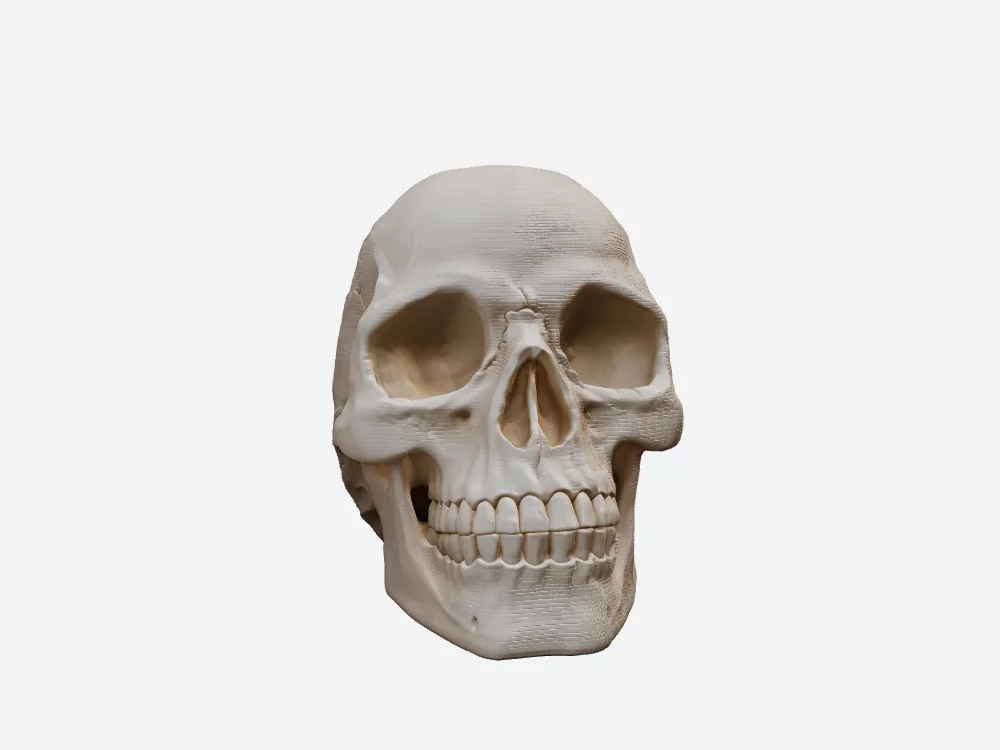 Tripo, front. Softer transitions, striped vault, shallower interdental grooves.
The tooth row: Tripo's incisors are the correct shape
Both models produced individual teeth rather than a fused ridge — this was one of the three things the case existed to test, and both passed. Every crown on both sides has an interdental groove deep enough to cast a shadow.
The difference is shape, and here Tripo is right and SupaVoxel is wrong. SupaVoxel's crowns are crisper and the grooves deeper, but its upper incisors taper toward the incisal edge and read as canines — fangs. Tripo's upper incisors are broad flat chisels, which is what a human incisor is. A sharper wrong answer is still a wrong answer; crispness is not a defence of a bad shape.
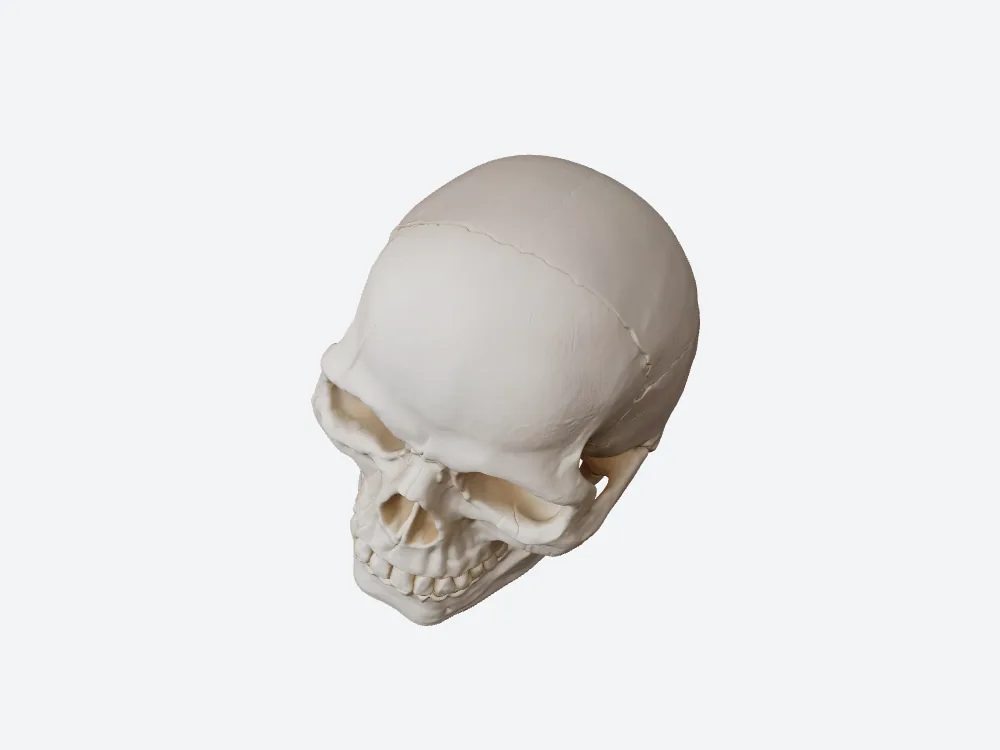 SupaVoxel, top. The coronal suture is cut as a jagged interlocking line and the vault around it is plain bone.
The zygomatic arch: Tripo's bridge is the better bridge
The third stress axis. Both models kept the arch as a genuine free-standing span with an open temporal fossa behind it. But Tripo's is thinner, and the shadow gap beneath it is cleaner and more continuous; SupaVoxel's is chunkier and merges into the mastoid region sooner.
Tripo wins the row. The exchange rate is 55 credits against 3 and 62.70 MB against 5.37 MB, plus a normals flip before the file slices — for one arch that photographs better.
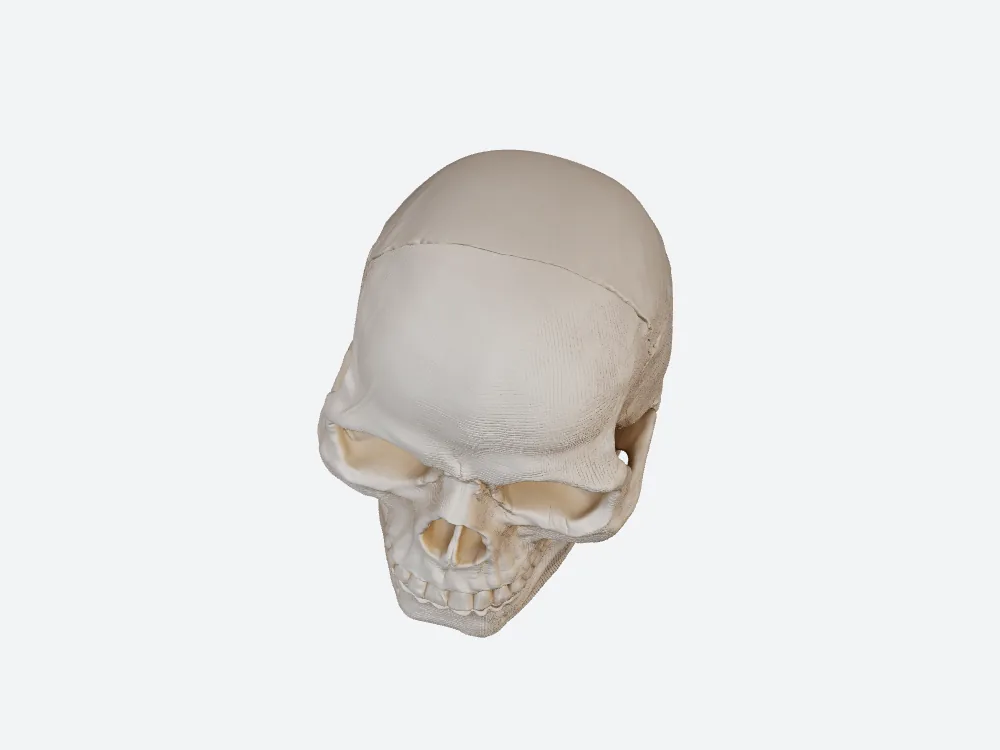 Tripo, top. A suture crosses the vault, but the parietal carries dense horizontal grain and the whole tone has drifted beige — Tripo learned the ornament's material as well as its shape.
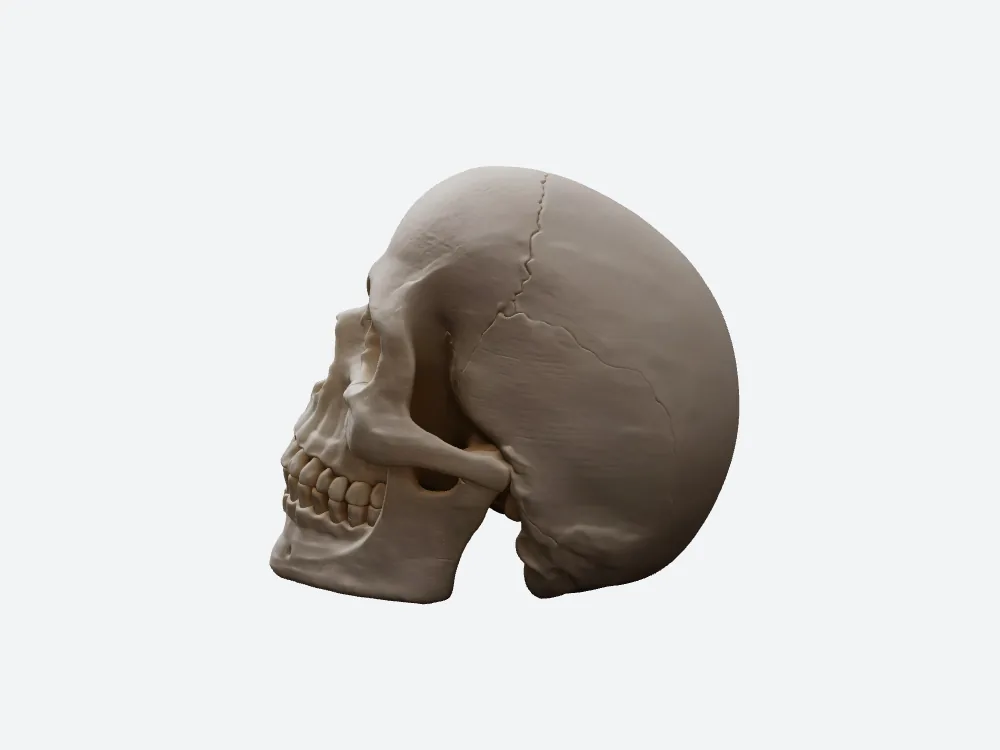 SupaVoxel, side. A real bridge with an open fossa behind it, thicker than Tripo's. The photograph's crack is translated into an incised jagged suture with a clean edge.
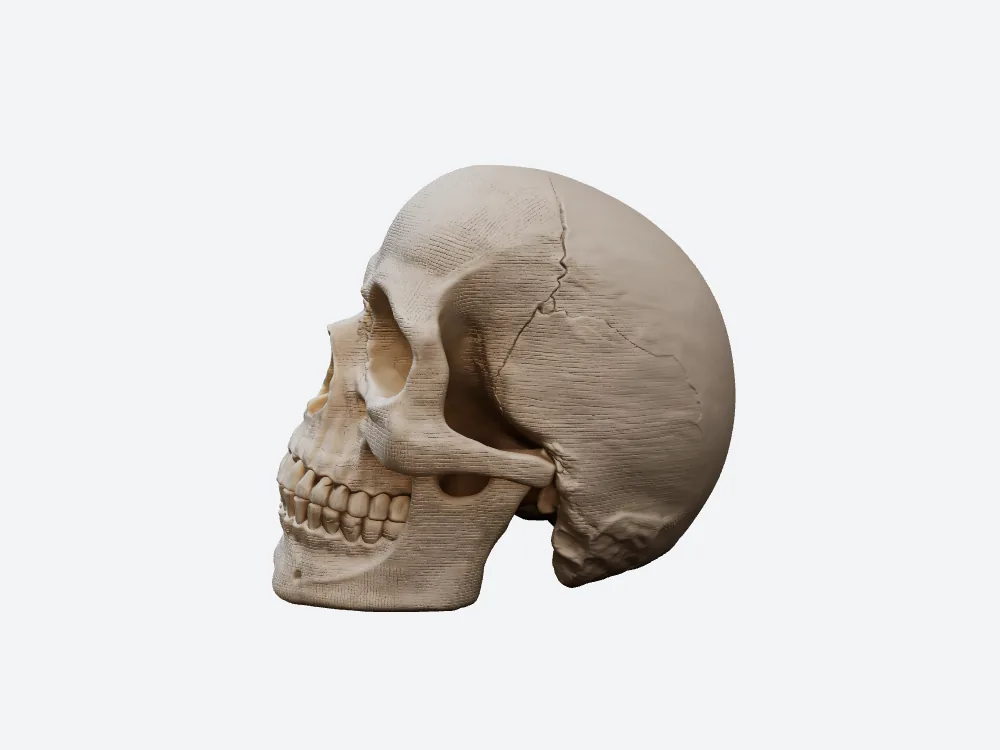 Tripo, side. A thinner, better-shadowed arch — Tripo's win — beside a crack rebuilt as a raised torn-lipped ridge and banding running frontal to occipital.
62.70 MB against 5.37 MB, and it is not the triangle count
Tripo's file is 11.67× the SupaVoxel one while carrying only 2.03× the triangles. The gap is compression: Tripo's GLB declares no compression extension at all (extensions_used is KHR_materials_volume and FB_ngon_encoding), so it costs 32.11 bytes per triangle. SupaVoxel's uses meshopt compression plus vertex quantisation, both marked required, at 5.59 bytes per triangle.
- Triangles — Tripo 1,952,540 · SupaVoxel 960,138 · 2.03×
- Vertices — Tripo 1,000,431 · SupaVoxel 496,054
- Bytes — Tripo 62,698,596 · SupaVoxel 5,370,696 · 11.67×
- Bytes per triangle — Tripo 32.11 · SupaVoxel 5.59 · 5.74×
7.25 MB of textures, of which 4.81 MB a slicer never opens
Tripo's baseColor is a 4096 JPEG at 2.44 MB against SupaVoxel's 2048 WebP at 0.28 MB. For rendering, Tripo wins that outright — 8.69× the pixels-per-byte budget is a real advantage on a hero shot.
Then there is the rest. Tripo's metallicRoughness plus normal maps total 4.81 MB — larger than its own baseColor — and 3.38 MB of that is a single uncompressed 4096 PNG normal map. SupaVoxel's equivalent pair is 0.23 MB, a 21.1× difference. On an FDM print run, not one byte of that 4.81 MB is read, and Tripo's export dialog pre-selects 4k (Current), so a print-only user takes it home by default.
41.8 seconds on a phone
- 12 Mbps 4G, first load — Tripo 41.8 s · SupaVoxel 3.6 s · 38.2 s difference
- 100 Mbps home, first load — Tripo 5.02 s · SupaVoxel 0.43 s
- Geometry VRAM — Tripo 55.4 MB · SupaVoxel 27.4 MB · 2.02×
Forty-two seconds of blank viewport on a phone is not a slow feature, it is an absent feature. The VRAM line decides whether a low-end handset opens the preview at all.
$53.29 a month against $4.57
Serve the model 10,000 times a month at $0.085/GB and Tripo's file bills $53.29 against SupaVoxel's $4.57. That is $48.72 a month and $584.60 a year, for the same skull, at the same camera, with the same empty occiput. The 11.67× byte ratio is the bandwidth bill, one to one, with no interpretation in between.
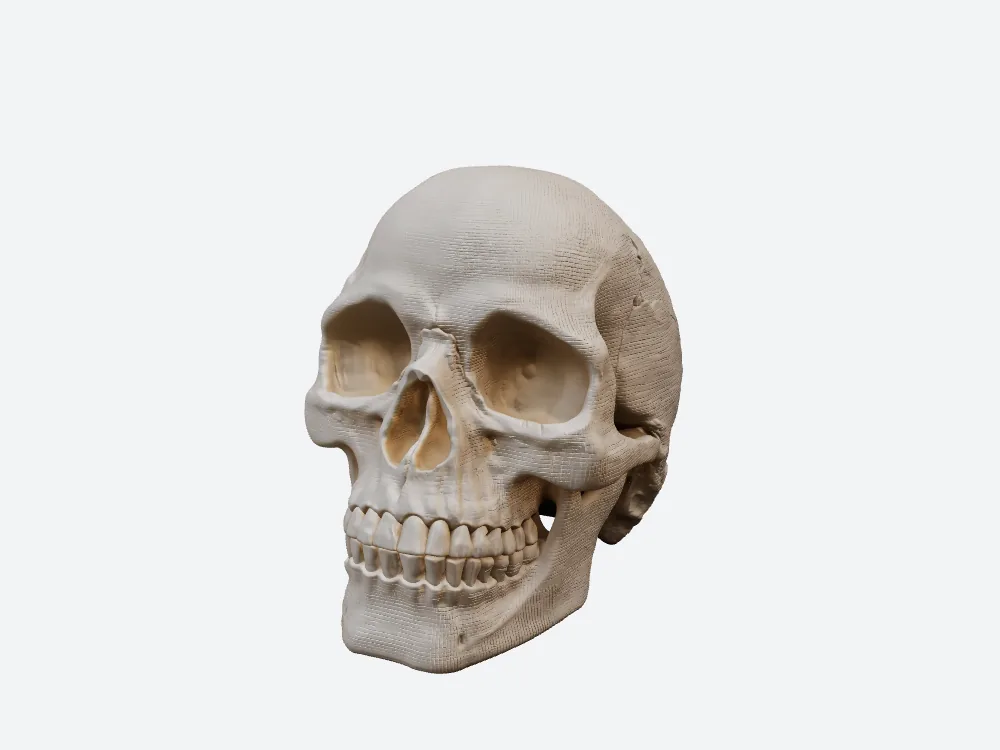 Tripo's result: 62.70 MB served every time.
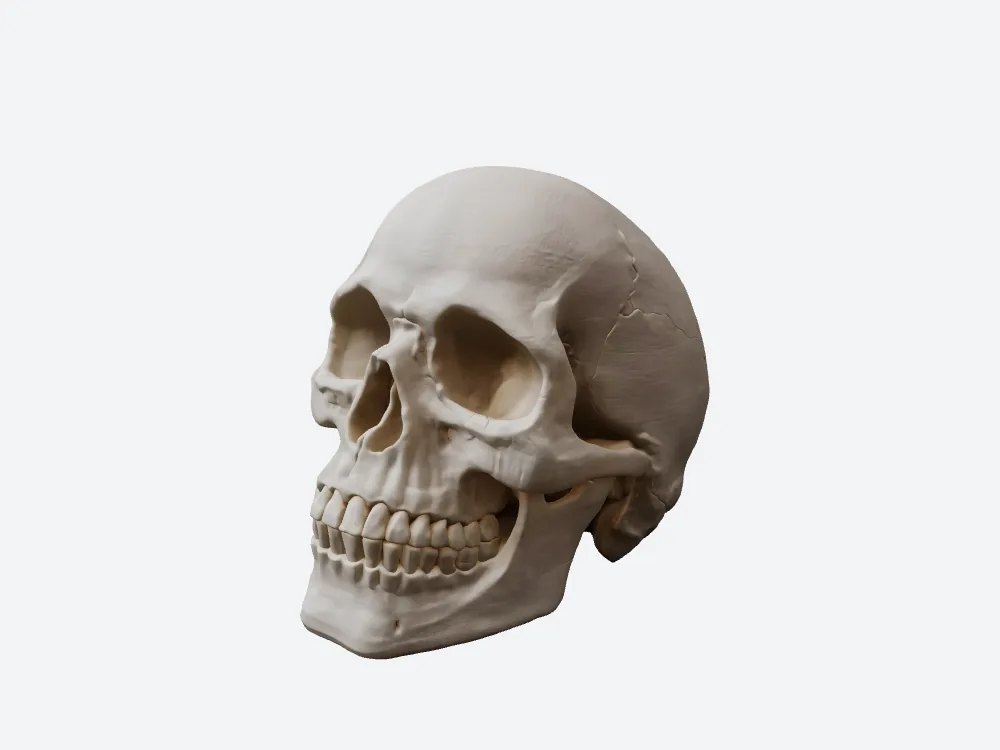 SupaVoxel's result at the same camera: 5.37 MB served every time.
1.95M triangles is Tripo's house budget, not a fidelity dial
Across nine cases run the same day on the same settings, Tripo's triangle count landed between 1,896,372 and 1,996,779 — a spread of 5.2% of the mean. A skull and a tank come back with the same number. SupaVoxel's, across ten cases, ranged from 945k to 2.79M, a spread of 146%, so its output moves with the subject.
Read that the right way round: the claim is not that SupaVoxel is leaner. It is that Tripo's mesh density looks like a fixed allocation that does not respond to the subject, so 1,952,540 triangles on this skull tells you about Tripo's budget, not about this skull. Small samples — n=9 and n=10, one day, one settings profile — quoted with that caveat attached.
What I could not measure
Three blanks, recorded as blanks. Tripo's full export format list was not captured: both dropdowns in the export dialog failed to expand in this run, so only GLB + 4k Current is on record, at two clicks to the file. My click count on the SupaVoxel side was not recorded. And the wireframe-zoom renders are invalid evidence on both sides at these densities — at 1,952,540 and 960,138 triangles they resolve to near-black blobs, so every thin-structure judgement here comes from untextured mesh renders and tight crops instead.
Final verdict: Tripo scores 60/100 on likeness and payload
Tripo has the better baseColor texture, the better zygomatic arch and the anatomically correct incisors. Tripo also has the ornament's wood grain displaced into its geometry, a rear view with a torn artefact ridge on it, 62.70 MB, 41.8 seconds on 4G, $584.60 a year of bandwidth, and no more occipital anatomy than the 5.37 MB file. SupaVoxel scores 90/100 — clean bone, 3.6-second loads, $4.57 a month — with its own real losses on the record: incisors shaped like fangs, and a rear view that is just as invented. One image, one run each: a data point, not a benchmark.
Which one I would use for this job
5.37 MB, 960,138 triangles, 3.6 seconds on a phone and $4.57 per 10,000 loads, from the same single photograph — supavoxel.com. Upload a reference, then spin the result to the back and judge the half the camera never saw for yourself; that is the half that decided this test.
Originally published on Medium: Tripo AI 3D Review 2026: 62.7 MB and an Empty Back of the Skull.